



European Furniture Industry 2026 - Report by CSIL
Europe continues to hold a crucial position in the global furniture industry—not only in production, but in market size, trade weight, product innovations and design. In 2025, the European furniture ecosystem combines scale with density: around EUR 104 billion in production and EUR 110 billion in consumption, supported by an industrial base of roughly 138,000 companies and over 1 million employees.
This is not just a question of volume; it is also about capabilities. Europe’s manufacturing clusters and supplier networks have historically enabled fast response to changing demand—whether the shift is toward higher customisation, stronger sustainability attributes, or specific design languages that travel across borders and channels.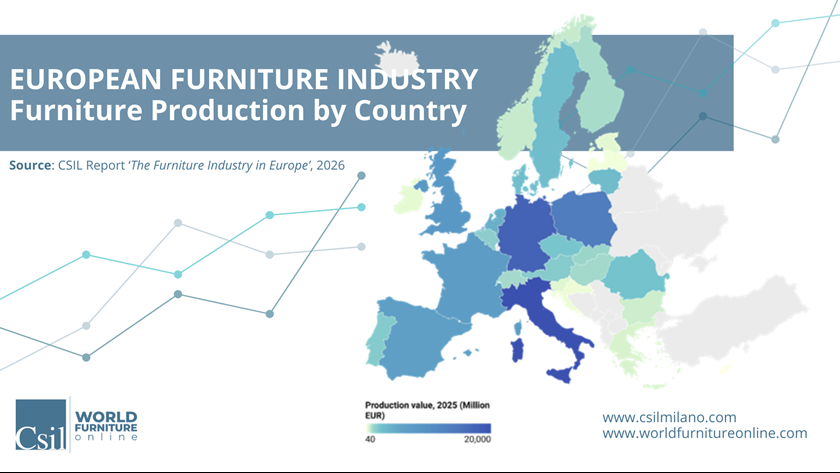
Europe’s furniture industry closed 2025 with a slight decline overall, as weak household purchasing power, cautious consumer behaviour, subdued housing activity and persistent cost pressures combined into a year defined above all by uncertainty. The second half of 2025 was more supportive than the first—orders and activity stabilised in several markets—but the dominant message from manufacturers is that volatility is reshaping decisions across the value chain and that uncertainty has shifted from a background condition to the central driver of boardroom priorities. While the sector has proven resilient, the current environment is visibly altering investment timing, trade flows and competitive dynamics.
A market moving at different speeds across countries
Across Europe, the underlying challenges are broadly shared, but the intensity differs by national context. France and Germany posted the weakest results, reflecting very soft domestic demand and low consumer confidence. Italy recorded a modest contraction, driven mainly by weaker exports and a slight decline in the home market. By contrast, Spain delivered a positive performance in 2025, supported by firmer household spending and a more dynamic housing cycle. Several Eastern European producers—including the Czech Republic, Slovakia and Lithuania—performed comparatively better thanks to more resilient export activity. Poland, despite growth in real terms as prices fell, remained under strain from weak demand, declining selling prices, raw-material constraints and costs, and rapidly rising wages that compressed operating margins.
Furniture production by country, 2025
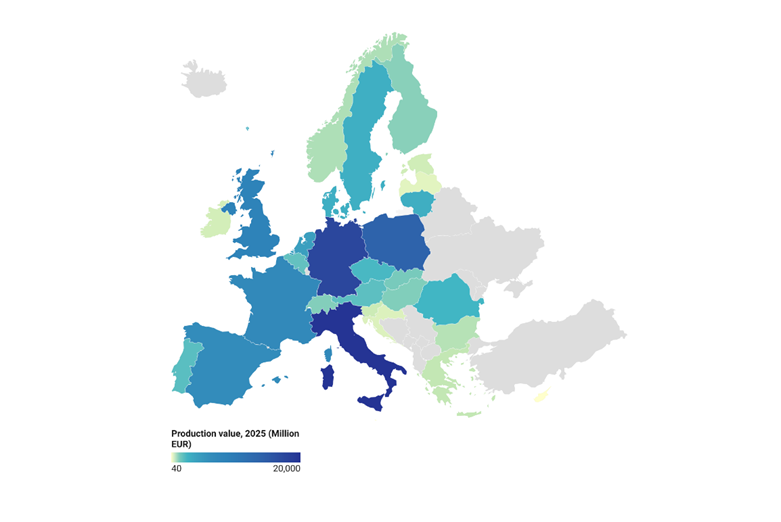
Source: CSIL
Europe’s macro-outlook: modest growth, disinflation, but policy and geopolitics weigh on confidence
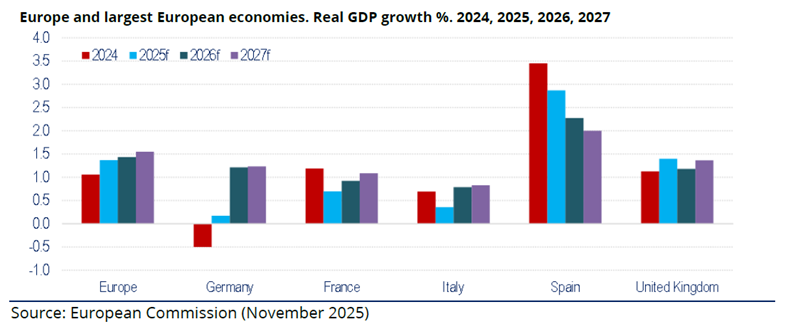
In Europe, the European Commission’s Autumn 2025 Economic Forecast projects EU real GDP growth of 1.4% in 2025 and 2026, edging up to 1.5% in 2027, with inflation in the EU projected at 2.5% in 2025, easing to 2.1% in 2026 and 2.2% in 2027. These conditions should gradually help household purchasing power—yet the same forecast underlines that trade-policy uncertainty remains a drag on economic activity, and that tariff-related disruptions can weigh on exports and investment.
The sector’s trade reality: external headwinds are intensifying
For furniture manufacturers, the export story is becoming more complex. The export orientation toward non-European markets (representing about 12% of European production) is gradually weakening, with uncertainty now the dominant factor shaping business decisions and trade flows. This reflects a tougher global trade environment and the cooling of extra-European demand prospects—particularly in the United States—at a time when domestic European demand remains weak. In short, extra-European export momentum is not currently strong enough to compensate for subdued household demand or to sustain output growth across Europe.
In parallel, extra-EU imports are gaining weight in the European market, underscoring both Europe’s openness and the intensifying competitive pressure on domestic producers. CSIL data show that supplies sourced from outside the EU now account for about 22% of the European furniture market, up from 18% in 2019, signalling a gradual but clear increase in reliance on non-European manufacturers. China remains by far the leading external supplier, followed by Turkey and Vietnam—a shift that is reshaping pricing dynamics, category competition and sourcing strategies for retailers.
Forecasts: flat in 2026, slight improvement in 2027—under higher-than-usual uncertainty
CSIL estimates point to a cautious baseline. After two difficult years, world furniture consumption is expected to increase by around 1.2% in 2026 and 1.4% in 2027, but with substantial downside risks linked to geopolitics and protectionism. In Europe, furniture demand is forecast to remain almost stagnant in 2026, as households continue to prioritise savings and shift spending toward experiences over durable goods. With geopolitical risks still high, domestic demand should remain weak, while external demand faces additional headwinds from tariffs and a volatile trade environment. A slight improvement is expected in 2027 (around +1.1%), supported by modest macro improvements, a gradual rebound in purchasing power and a recovery in the housing sector—factors that could lift consumer confidence and encourage furniture spending, with Spain expected to be among the strongest performers.
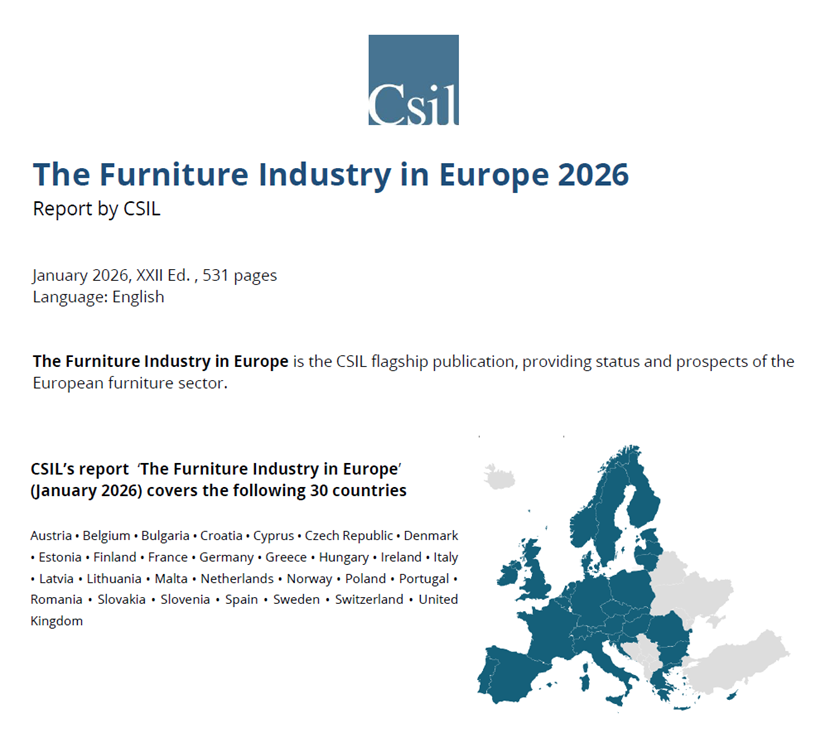
For a detailed description of the The Furniture Industry in Europe 2026 report, please visit the page: https://www.worldfurnitureonline.com/report/the-furniture-industry-in-europe